
Greetings, TTP family! We’re excited to welcome you back to another journey into God’s timeless Word as we continue contending for truth in an age of shifting voices.
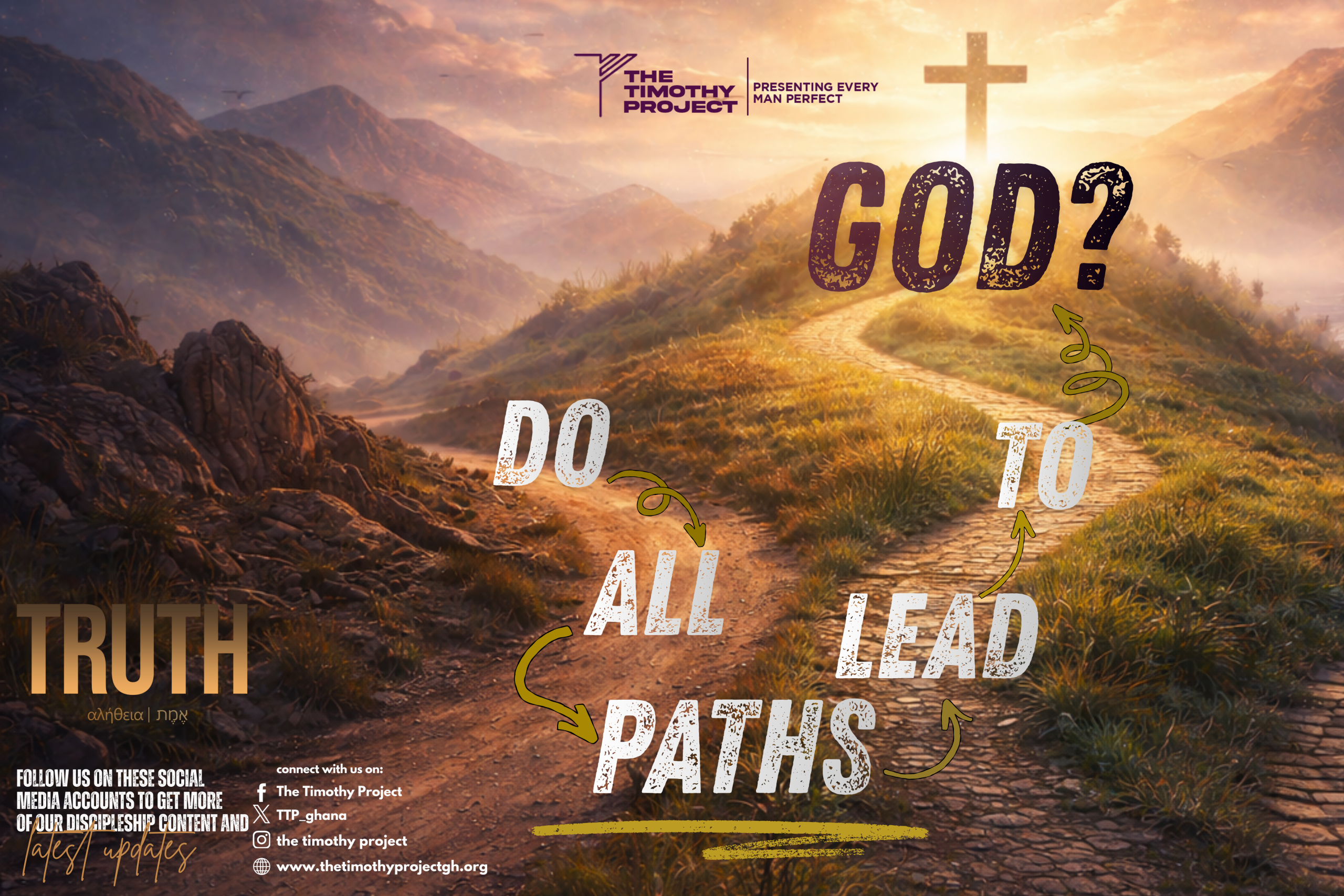
Today we lean into a question that reverberates through our culture: Do all paths ‘really’ lead to God? In a world that prizes tolerance and inclusivity, claiming there is only one way can sound old-fashioned or even offensive. Yet beneath the surface of this popular idea lies a tension worth examining. Can every path, with its differing claims, truly lead to the same destination?
Scripture answers with clarity and conviction. Peter, standing boldly before the Sanhedrin, declared: “There is salvation in no one else, for there is no other name under heaven given among men by which we must be saved.” (Acts 4:12). That statement doesn’t just challenge cultural assumptions, it forces us to face the reality of truth itself.
The claim that “all paths lead to God” may feel inclusive, but it unravels when examined closely. Not every path even agrees on who God is. And if the truth is absolute, it cannot contradict itself. This is why our pursuit today is not about narrowness, but about clarity – the clarity that comes from God’s own revelation through Jesus Christ.
The Problem with “All Paths”
Let’s imagine someone in New York trying to get to Toronto. If they head south toward Florida, west to California, or east into the Atlantic Ocean, can they really expect to arrive in Toronto? Of course not. Direction matters. Truth is directional.
The idea that every religious or philosophical path eventually leads to God ignores the reality of contradictions. Atheism says there is no God. Polytheism says there are many. Monotheism insists there is one. Panentheism says God is inseparable from the universe. These claims cannot all be equally true at the same time.
To affirm them all is not tolerance—it is incoherence.
C.S. Lewis put it well: “One must keep on pointing out that Christianity is a statement which, if false, is of no importance, and if true, is of infinite importance. The one thing it cannot be is moderately important.” If all religions were equally valid, truth itself would cease to matter.
The Landscape of Belief
Across history and cultures, humanity has wrestled with the question of God’s existence and nature. The paths may be many, but they diverge widely in their claims:
- Atheism denies God altogether, insisting that there is no divine being behind the universe.
- Polytheism affirms the existence of many gods, each limited to certain powers, places, or domains.
- Monotheism proclaims one sovereign God over all things, embraced in Judaism, Christianity, and Islam, though with differing understandings of His nature.
- Panentheism suggests that God permeates everything, present within creation yet distinct from it.
- Pantheism blurs the line entirely, claiming that everything is God, equating creation itself with divinity.
Each belief system paints a different portrait of reality. And while culture often suggests these paths ultimately meet, their core differences reveal that they cannot all be leading to the same God.
This is where the question sharpens: if all views cannot be equally true, then which one best explains reality?
The Case for One God
Philosophically and logically, the belief in one God holds the strongest ground. Consider the alternatives:
- If there were many gods, none could truly be supreme. Reality itself would be divided, fractured by competing powers. This directly challenges polytheism, which limits divinity to multiple competing beings.
- If God is infinite, there cannot be more than one infinite being, otherwise neither would truly be infinite. This pushes back against both polytheism and panentheism, for if divinity is shared or divided, it cannot be absolute.
- If God is Creator, then everything else belongs to creation. That alone sets Him apart from idols, spiritual forces, or abstract “energies.” This refutes pantheism, which equates creation itself with God, and panentheism, which blurs the line between Creator and creation.
This is why the Bible consistently affirms the reality of one sovereign God – holy, eternal, and unmatched. “Hear, O Israel: The LORD our God, the LORD is one.” (Deuteronomy 6:4).
Why Jesus Alone?
So if there is one God, the next pressing question is: How do we get to Him? And if we claim Jesus is that one way, why would it be Him?
- The Uniqueness of His Person
Jesus is not merely another prophet or sage. He is the eternal Son of God made flesh (John 1:14). No other religious founder ever made such a claim and validated it through power over sin, sickness, nature, and death.
Lewis’ famous “trilemma” helps here: Jesus cannot be simply a good teacher. If He claimed to be God, He was either a liar, a lunatic, or Lord. Neutral ground does not exist. - The Sufficiency of His Work
Religion is humanity’s attempt to reach God through rituals, laws, or philosophies. Christianity is God reaching humanity through Christ. On the cross, Jesus bore our sins, satisfying divine justice and reconciling us to the Father (2 Cor 5:21). - The Universality of His Invitation
Jesus’ invitation is not tribal or limited. He says: “Come to me, all who labor and are heavy laden, and I will give you rest” (Matt. 11:28). His call transcends geography, culture, and background. - The Victory of His Resurrection
The greatest leveler of humanity is death. Kings and beggars alike return to the dust. Prophets may warn of it, philosophers may theorize about it, but only Jesus walked into the grave and walked back out. His bodily resurrection is not symbolic—it is historical. Paul anchors the entire Christian faith on this fact: “If Christ has not been raised, your faith is futile” (1 Cor 15:17). But He has been raised. In conquering death, Jesus proved that He alone holds the keys of life and eternity (Rev 1:18).
So, do all paths lead to God?
The truth is, no – they cannot. The roads diverge too sharply. Some deny His very existence, others distort His character, and many offer self-effort as the cure for a broken world. But only in Christ do we see the true God stooping down in love, offering reconciliation, and sealing it with the victory of the empty tomb.
Not all paths lead to God, but the beauty of the gospel is this: the one true path – Jesus Christ welcomes all who believe, leading them to life everlasting. As Peter boldly proclaimed before the Sanhedrin, “There is salvation in no one else.” (Acts 4:12).
We encourage you to engage with this content: leave your thoughts, questions, or insights in the comments, and share this with others. Then we also encourage you to dive deeper, study the Scriptures, explore the nature of God, and strengthen your ability to defend the gospel. Scripture calls us to be ready “to give a defense to anyone who asks for the reason for the hope that is in you” (1 Peter 3:15).
Continue this journey with us through future blogs, podcasts, and reflections as we pursue truth, grow in grace, and walk the narrow path that leads to life. Until next time, may the peace of Christ guard your hearts and minds. Shalom, and God bless you.
The Timothy Project… Presenting every man perfect.